Enlightenment Edinburgh - a walking guide
Hume, Smith and the city that for a few decades thought harder than anywhere in Europe.
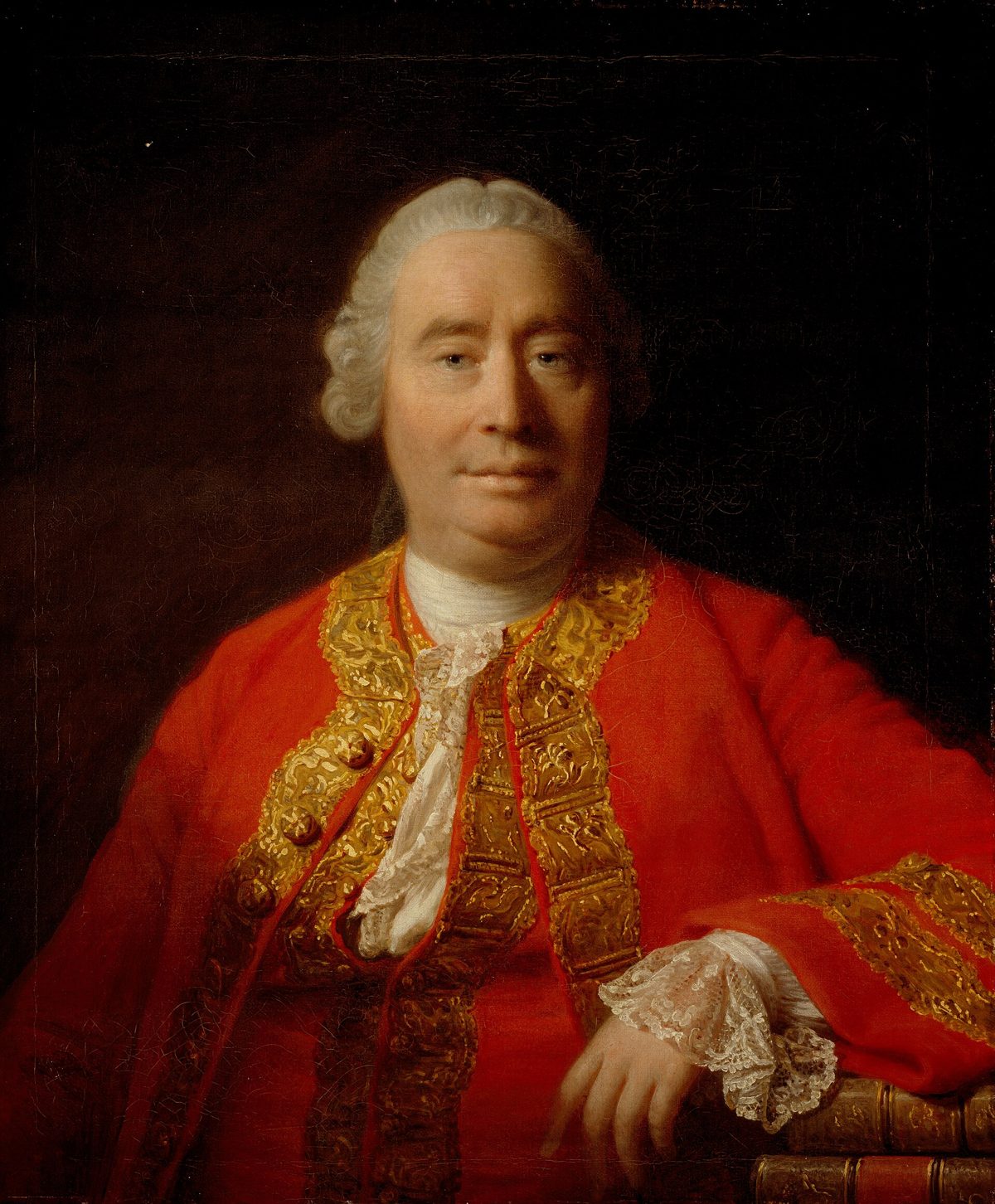
The Scottish Enlightenment left its mark on Edinburgh in stone, bronze, and burial grounds that you can still visit on foot. This guide links six sites tied to David Hume, Adam Smith, and the city's medical and university culture, with plain explanations of the ideas and what to look for at each stop. - David Hume statue on the Royal Mile - Panmure House, Adam Smith's home - Canongate Kirkyard, where Smith is buried - Old College of the University of Edinburgh - Old Calton Burial Ground and Hume's tomb - Surgeons' Hall
David Hume statue on the Royal Mile
The bronze statue of David Hume stands near St Giles' Cathedral on the Royal Mile. Hume was the philosopher who argued that knowledge comes from experience and that human reason is weaker than we like to think. His major works include A Treatise of Human Nature and An Enquiry Concerning Human Understanding. At the statue, look at the open book in his hand and the polished toe: generations of visitors have rubbed it for luck, a habit Hume himself would probably have found amusing.
Hume's scepticism about causation and miracles made him one of the central figures of the Scottish Enlightenment. He also wrote essays on politics, economics, and history, and his style made philosophy readable for educated lay readers. The statue is not a grand monument to a remote genius; it places Hume in the middle of the Royal Mile, where students, tourists, and locals pass every day.
Panmure House, Adam Smith's home
Panmure House in the Canongate area was Adam Smith's home in his later years. Smith wrote The Wealth of Nations and The Theory of Moral Sentiments, arguing that markets work through self-interest guided by sympathy and competition, while warning against monopolies and mercantile privilege. The house survives as a restored building now used by Edinburgh Business School at Heriot-Watt University. Look at the exterior and the way it sits in the old Canongate streetscape rather than as a museum interior.
Smith's importance lies in connecting moral philosophy to economic life. In The Theory of Moral Sentiments, he examined how people judge one another through sympathy. In The Wealth of Nations, he analysed division of labour, prices, wages, and the dangers of privileged companies. Panmure House matters because it reminds visitors that Smith was not only an abstract theorist; he lived in Edinburgh and worked in the Canongate.
Canongate Kirkyard, where Smith is buried
Canongate Kirkyard holds Adam Smith's grave, marked by a simple stone. It is a small churchyard behind the Canongate Kirk on the Royal Mile. Smith's burial reflects his modest life despite his fame. Look for his headstone among the older stones; the plainness of the marker fits a man who wrote about ordinary life and everyday commerce.
The kirkyard also gives a sense of Edinburgh's social mix. Merchants, artisans, and public figures were buried there, and the churchyard sits close to the street rather than in a separate monumental landscape. Smith's grave is therefore easy to miss unless you know what to look for, which suits his reputation for modesty.
Old College of the University of Edinburgh
Old College is the Enlightenment-era home of the University of Edinburgh, largely designed by Robert Adam and completed in the early nineteenth century. Hume and Smith both had ties to the university: Hume as a student and Smith as a professor. The building survives as a quadrangle with a central dome. Look at the dome, the classical facade, and the way the college frames the idea of a public university serving a civic culture.
The university was central to the Enlightenment in Edinburgh because it brought together students, professors, and civic institutions. Medicine, philosophy, law, and natural philosophy all had homes there. Old College is not just an architectural set piece; it represents the idea that knowledge should be organised, taught, and tested in public institutions.
Old Calton Burial Ground and Hume's tomb
It is one of the clearest pieces of Enlightenment architecture in the city. Look at the round temple form and the inscription; the design treats philosophy as something worthy of a public monument, not a private study.
The tomb's classical form connects Hume to the republican and civic traditions that influenced Enlightenment thought. Its location on Calton Hill also links philosophy to Edinburgh's wider cityscape. The monument is a reminder that Hume's reputation grew after his death, and that his friends and supporters wanted his memory preserved in a civic setting.
Surgeons' Hall
Surgeons' Hall houses the museum of the Royal College of Surgeons of Edinburgh. It connects to the medical side of the Enlightenment, when Edinburgh became a centre for anatomy, surgery, and clinical teaching. The building survives with its museum collections of instruments, specimens, and surgical history. Look at the anatomical preparations and the portraits of surgeons; they show how medicine moved from craft to science in the eighteenth century.
Medical teaching in Edinburgh attracted students from Britain and abroad. Surgeons and anatomists worked in a culture of observation, dissection, and comparison. The museum at Surgeons' Hall preserves that shift from practical skill to systematic knowledge, and it shows that the Enlightenment was not only about philosophy and economics.
Frequently asked questions
Who is the David Hume statue on the Royal Mile connected to?
It commemorates David Hume, the Scottish philosopher and historian whose works on human nature, causation, and scepticism shaped modern thought. The statue is a public monument on the Royal Mile near St Giles' Cathedral.
Where is Adam Smith buried in Edinburgh?
Adam Smith is buried in Canongate Kirkyard, behind Canongate Kirk on the Royal Mile. His grave is marked by a simple stone, in keeping with his modest personal life.
What is special about Old Calton Burial Ground for the Scottish Enlightenment?
It contains David Hume's tomb, a circular classical monument designed by Robert Adam. The monument is a key piece of Enlightenment architecture and marks the grave of one of the movement's central thinkers.
This is an independent member's guide compiled by Edinburgh Society. We are not affiliated with the venues and institutions mentioned; opening arrangements and programmes change - always confirm details on the official websites before making plans.
← Back to Events